
Masculine Brow Geometry: Why Men’s Brows Need Their Own Design Rules
Writer: Ira Bale
A man once sat in my chair and said:
“I want them cleaner, but I don’t want anyone to know I’ve had them done.”
That sentence explains almost everything about good men’s brow design.
Most men are not looking for a dramatic new shape.
They want less disorder.
Better balance.
A cleaner expression.
Perhaps more density where age, scarring or over-trimming has created gaps.
What they do not want is a brow that looks drawn, sculpted or borrowed from someone else’s face.
This is why men’s brows need their own design rules.
Men’s Brows Are Not Women’s Brows With Less Product
For years, the beauty industry treated men’s brow services as a simplified version of women’s brow shaping.
The same mapping.
The same arch.
The same polished finish.
Just slightly thicker.
That approach misses the point.
Men’s brow design is not simply about leaving more hair behind. It requires a different understanding of facial structure, brow position, texture and expression.
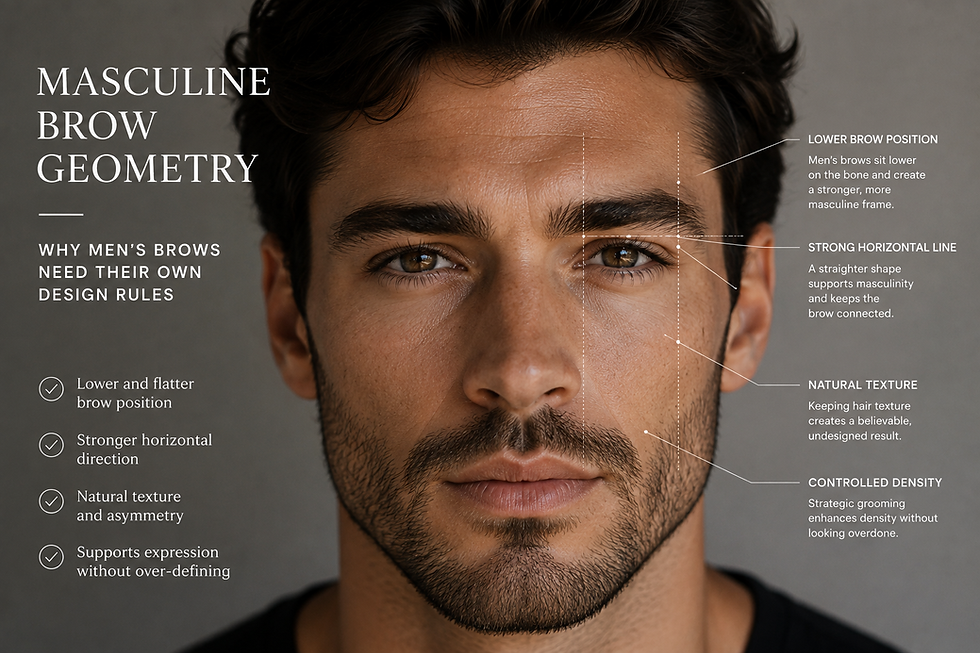
Anthropometric research has found that male brows tend to sit lower over the orbital rim and often appear flatter than female brows. Studies of facial perception also suggest that the brows, jawline and overall facial height contribute to how masculinity and dominance are read in a face.
The goal is not to exaggerate those cues.
It is to avoid accidentally removing them.
The Brow Sits Inside a Larger Structure
A masculine brow does not exist by itself.
It works with the forehead, brow bone, eyes, temples, nose, jaw and facial hair.
A broad face may suit a stronger horizontal brow.
A narrow face may need more control through the tail.
Deep-set eyes can carry greater density above them.
A softer face may benefit from preserving texture rather than creating a sharp border.
This is why fixed brow measurements are unreliable.
A formula may tell you where a brow should begin or finish.
It cannot tell you whether that shape belongs on the face.
The same arch that lifts one expression can feminise or over-polish another.
Why Straightness Matters
Many naturally masculine brows have a stronger horizontal direction.
That does not mean every man needs a perfectly straight brow.
It means the design should usually respect the relationship between the brow and the underlying orbital structure.
A high, narrow arch can separate the brow visually from the brow bone.
The result may look surprised, highly groomed or simply unfamiliar.
Clinical reviews of brow aesthetics have similarly described male brows as heavier, lower and flatter, while also warning that excessive elevation can create an unnatural expression.
The right amount of curve depends on the individual.
Some men naturally have a gentle rise.
Others have a very flat shape.
The mistake is not creating an arch.
The mistake is assuming an arch is always an improvement.
Texture Is Part of the Design
Women’s brow treatments often aim for visual smoothness.
Men’s brows usually need to retain more irregularity.
A few hairs growing slightly differently can make the result feel believable.
Perfectly aligned hairs can look too arranged.
A sharply carved lower line can look drawn.
A uniformly dark tint can turn natural density into a solid block.
This is where technical restraint matters.
We may remove obvious stray hairs, reduce bulk in selected areas and control hairs that distort the shape.
But we do not try to make every strand behave identically.
Controlled asymmetry often looks more masculine than perfect order.
The Most Common Mistake Is Over-Cleaning
A man may arrive with brows that feel messy.
The temptation is to create two crisp outlines.
That usually looks good for about five minutes in a close-up photograph.
In real life, it can appear overdone.
The lower edge becomes too sharp.
The upper texture disappears.
The arch becomes obvious.
Suddenly the brows are no longer supporting the face.
They are announcing themselves.
Good men’s brow shaping is often less about creating a new shape and more about revealing the strongest version of what is already there.
A Client Who Wanted “Just the Middle”
One client booked because he was tired of trimming the centre of his brows himself.
He assumed we would simply remove the hair between them.
But the middle was not the only issue.
One brow carried more density through the front, while the other became thinner near the arch. The tails also dropped slightly, making his expression appear heavier than it was.
He still did not want a visibly groomed result.
So we did very little.
We cleared the centre conservatively.
Removed a few hairs that pulled the tails downward.
Reduced bulk where one brow looked heavier.
Left the natural upper line untouched.
When I handed him the mirror, he looked for a moment and said:
“They just look like my brows, but better.”
Exactly.
Symmetry Is Not the Goal
Men’s faces are often made more interesting by controlled asymmetry.
One brow may sit slightly higher.
One eye may be more open.
The jaw may be stronger on one side.
Trying to force the brows into identical shapes can make those differences more visible rather than less.
Research on facial perception has shown that eyebrows influence how expression, dominance and identity are read. Lower brow placement, for example, can contribute to stronger or more threatening impressions depending on the rest of the face.
That does not mean every uneven brow should remain untouched.
It means correction has to be selective.
Sometimes one brow needs to be softened.
Sometimes the other needs density.
Sometimes neither should be forced to match.
Balance is more useful than duplication.
Brow Lamination for Men Is About Direction
Brow lamination can work extremely well for men when it is used to control hair direction rather than create exaggerated upright brows.
Coarse hairs may grow downwards.
Long hairs may cross over one another.
A strong cowlick may distort the front of the brow.
Lamination can organise that movement and make the brow appear fuller and more intentional.
But the result should still look like hair.
Not a fan.
Not a glued vertical wall.
Not a social-media brow placed onto a masculine face.
For men, brow lamination is most successful when people notice the face looks cleaner but cannot identify the treatment.
Brow Tattooing for Men Requires Even More Restraint
Men may seek brow tattooing because of scars, thinning, alopecia, ageing or naturally low density.
The challenge is not simply replacing missing pigment.
It is restoring the visual logic of the brow.
A uniform block of colour rarely works.
Neither does copying a standard female brow pattern and making it thicker.
Men’s brow tattooing may require broken edges, varied density, preserved skin visibility and deliberate irregularity.
The front should not look stamped.
The tail should not become too neat.
The colour must sit naturally beside facial hair, scalp hair and skin tone.
The best men’s brow tattoo should be difficult to detect.
It should look like the face has always had more structure.
Darkness Does Not Automatically Mean Masculinity
Thicker brows are often perceived as more masculine or dominant, but that does not mean the darkest possible brow is the correct one. Research suggests that eyebrow prominence can contribute to perceptions of masculinity, although its effect depends on the wider face and is not a universal rule for attractiveness.
A tint that is too dark can flatten natural hair texture.
A tattoo that is too dense can overpower the eyes.
A heavy front can make the expression look severe.
Strength comes from proportion.
Not from maximum colour.
Men’s Brows Should Look Undesigned
This sounds like a contradiction.
It is not.
A well-designed men’s brow may involve careful analysis, selective hair removal, colour adjustment, lamination or discreet cosmetic tattooing.
But the final result should not display the effort.
The structure should feel natural.
The texture should remain believable.
The two brows should relate without becoming identical.
The face should look more ordered without looking decorated.
That is the real standard for men’s brow work.
Not perfection.
Not sharpness.
Not a fashionable arch.
Recognition.
The man should still see his own face.
Just without the visual noise.
References
Pietruski, P. et al. The Male Eyebrow and Eyelid: An Anthropometric Analysis of Caucasian Professional Models. Aesthetic Plastic Surgery, 2023.
Mogilski, J. K. and Welling, L. L. M. The Relative Contribution of Jawbone and Cheekbone Prominence, Eyebrow Thickness, Eye Size and Face Length to Evaluations of Facial Masculinity and Attractiveness. Frontiers in Psychology, 2018.
Yalçınkaya, E. et al. Aesthetic Analysis of the Ideal Eyebrow Shape and Position. European Archives of Oto-Rhino-Laryngology, 2016.
Zebrowitz, L. A. and Montepare, J. M. Social Psychological Face Perception: Why Appearance Matters. Social and Personality Psychology Compass, 2008.
Little, A. C., Jones, B. C. and DeBruine, L. M. Facial Attractiveness: Evolutionary Based Research. Philosophical Transactions of the Royal Society B, 2011.
Related Reading
Facial Aesthetics
Brow Tattoo
Brow Lamination
Brow Lamination vs Brow Tattoo: Which One Is Right for You?


Comments